How to practice with a goal
Playing a piece from the top again and again feels like practice. But most of that time goes to the parts you can already play, and the hard spots only get one quick try each time through. Practicing with a goal works the other way around. You pick one small spot, decide on one thing to fix there, and work on it until it gets better.
Each round has four steps and takes about five to ten minutes. Then you start again with a new spot, or with the same one if it still needs work.
The four steps
- Step 1Choose a spotA few measures you can't play well yet
- Step 2Pick one skillThe one thing that needs the most work there
- Step 3Try ways to fix itSlow it down, break it into pieces, and repeat it correctly
- Step 4Check how it wentDecide if it got better and what to do next
Step 1: Choose a spot
A spot is a short part of your music, usually 1 to 8 measures. If a spot still isn't getting better after a few minutes of work, it's probably too long, so split it into smaller pieces.
Here are some ways to find the spots that need work:
- Keep a pencil on your stand in band. When something goes wrong, put a small check mark above those measures so you remember to practice them at home.
- Think about where you stop, slow down, or guess when you play the piece.
- Look for the places where your director stopped the band to fix something.
You don't have to start at the beginning of the piece. The last page often gets the least practice, because it always comes last. Once your spots are fixed, practice the measures that connect them too, so the music doesn't fall apart on the way into or out of a spot.
Step 2: Pick one skill
Getting a spot right takes more than the right notes. Choose the one skill that needs the most help. If several things are wrong, start with the notes and the rhythm, because it's hard to work on the others until those are right.
| Skill | Ask yourself |
|---|---|
| Notes | Am I using the right fingerings, slide positions, or stickings? Am I remembering the sharps and flats? |
| Rhythm | Does each note start on the right count and last for the right number of beats? |
| Tempo | Am I playing at the right speed, and keeping the same speed the whole time? |
| Articulation | Are the notes tongued, slurred, short, or accented the way the music shows? |
| Tone | Is my sound full and clear, even on high, low, and loud notes? Am I sitting or standing tall, with my shoulders and hands relaxed? |
| Tuning | Am I in tune with the band, a drone, or a tuner? |
| Dynamics | Am I playing as loud or soft as the music says? Do my crescendos and decrescendos really change? |
| Phrasing | Does the music keep moving to the end of each phrase, without breaths in the wrong places? |
For each skill, A practice fix-it list has more questions to check and ideas to try.
Make the goal small
A good goal says which measures, which skill, and how you'll know you reached it. "Get better at the song" is too big to finish in one practice. The smaller goals below can be finished in one practice, or at least come close.
| Too big | Small enough |
|---|---|
| Learn the fast part | Play the eighth notes in measures 21–24 evenly at quarter = 72, three times in a row |
| Get the rhythm right | Count and clap measures 9–12 with no mistakes, then play them with the same rhythm |
| Sound better | Hold the half notes in measures 1–4 with a full sound all the way to the end of each one |
| Play the dynamics | Make the crescendo in measures 13–16 grow a little at a time from soft (p) to loud (f), with no harsh sound at the top |
| Practice the snare part | Play measures 5–8 with the stickings written in my part, at quarter = 90 |
Try writing a goal for a spot in your own music. Change the boxes, and the goal changes with them.
Play measures 9–12 with the right rhythm at quarter = 80, three times in a row.
Write your goal in pencil above the measures or in a practice notebook. It only takes a few seconds, and it helps you remember what you were trying to do.
Step 3: Try ways to fix it
Now work on your goal. Ways to fix a hard spot in your music explains a lot of strategies, and these three help with almost any spot:
- Slow it down. Choose a tempo on the metronome where you can play the spot correctly, then speed up a little at a time.
- Make it smaller. Practice one measure, or even a few notes, and then put the pieces back together.
- Repeat it correctly. Try to play it right three times in a row. Playing the same mistake over and over practices the mistake.
You'll repeat the spot many times, but repeating shouldn't be the only thing you do. If a strategy isn't working after a few tries, switch to a different one, like changing the rhythm to train your fingers or building the spot from its last measure.
Step 4: Check how it went
Before you move on, stop and think about what happened. Ask yourself:
- Did the spot get better?
- Did I reach my goal?
- Which strategy helped the most? Did any of them not help?
- What should I work on next time?
Then decide what to do next:
| If | Then |
|---|---|
| You reached your goal | Play the spot with a measure or two before and after it, so it fits back into the music. Then pick a new spot, or a new skill for the same spot. |
| It got better, but you're not there yet | Keep the same goal for tomorrow. Start a little slower than where you ended today. |
| It didn't get better | Try a different strategy, make the spot smaller, or slow down more. If it's still stuck, ask your director for help. |
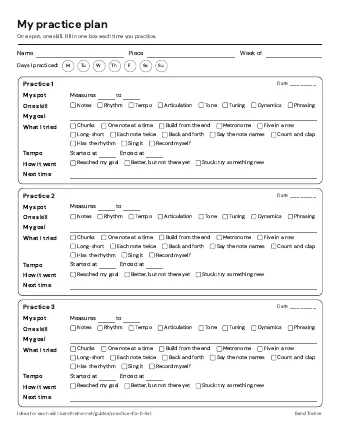
Recording the spot on a phone or tablet makes this step easier, because you hear things while you listen that you miss while you play. Then write a short note about what worked and what to do next time, so tomorrow you can start right where you left off. The printable practice plan has a box for each round, so you can fill it in as you go.
An example practice round
Say your band piece has a run of eighth notes in measures 17–20 that falls apart every time. Here's what one round could look like.
| Step | What you do |
|---|---|
| 1. Choose a spot | Measures 17–20. |
| 2. Pick one skill | You clap the rhythm, and it's right, so the problem is the notes: your fingers can't keep up. The music says quarter = 100, so that will take a few days. Today's goal: play the run with all the right notes at quarter = 80, three times in a row. |
| 3. Try ways to fix it | You set the metronome to 60. You say the note names while you finger them, then play the run long-short and short-long. When you can play it right three times in a row, you move the metronome up 4 beats per minute. |
| 4. Check how it went | You get to 76, just short of the goal. The long-short rhythms helped the most. Tomorrow you'll start at 72 and aim for 80. |
That round took about ten minutes. In a 15-minute practice, it leaves time to warm up and to play something you enjoy. How to practice at home in 15 minutes has an example plan to fit it into.
From Band Trainer · bandtrainer.net/guides/practice-with-a-goal